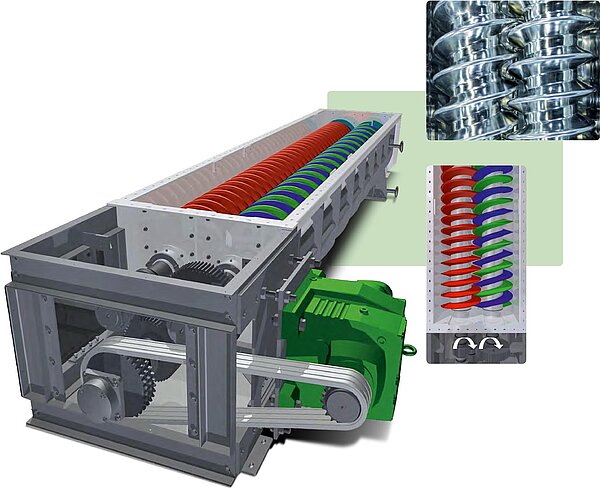
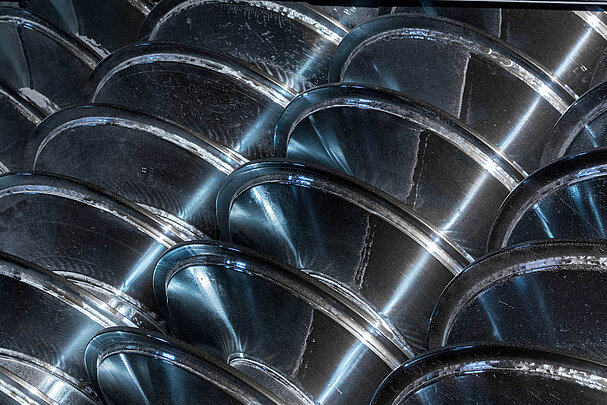
With the hollow flight principle, the screw flights are double-walled so that a heating or cooling medium can flow directly through them. This enables precise thermal treatment to cool or heat bulk solids efficiently or to keep them exactly at a constant temperature.
Unlike conventional designs, in which often only the housing and the shaft tube are temperature-controlled, energy transfer here does not depend solely on heat conduction via the joints. With the hollow flight principle, the medium flows through the cavity between the so-called "forward and return flights". Since these temperature-controlled surfaces are in constant contact with the bulk product, optimum heat exchange is guaranteed at all times.


The technology shows its strengths especially when cooling very hot bulk solids (> 900 °C). Since active internal cooling protects the flights from overheating, the materials always remain within their permissible operating limits.
In concrete terms, this means:
By actively using the entire flight surface, a larger total area is available for energy exchange. This opens up decisive design advantages: either the machine size can be reduced or the product throughput can be increased significantly. The hollow flight principle thus enables maximum performance in the smallest space and offers advantages in terms of maintenance and space requirements.
Since some bulk products have a strong tendency to adhere and form bridges, they pose a challenge for conventional systems. The effects differ depending on the application: in screw conveyors, such deposits prevent reliable material transport, while in screw heat exchangers they form an insulating layer on the flights, so that hardly any energy can be transferred.
The proven KÖLLEMANN self-cleaning principle solves these problems. It enables conveying and thermal treatment even of highly viscous, pasty consistencies (e.g. tough sludges or doughs). This principle is often used for demanding materials such as moist pulverized coal, cement, sewage sludge, plastics and methyl cellulose.
Thanks to effective cleaning, the systems operate with minimal residues on the shafts, which secures throughput in conveyors and maintains thermal efficiency in heat exchangers.


The self-cleaning principle is based on a special twin-shaft design. The two shafts rotate in the same direction but, thanks to a defined speed differential, generate a high lateral velocity between the surfaces.
Specifically, this is achieved by the following configuration:
This combination causes continuous mutual cleaning of the shafts. Our product range covers all necessary designs and materials. A wide variety of options allows the system to be adapted precisely to special customer requirements and the respective bulk solids.
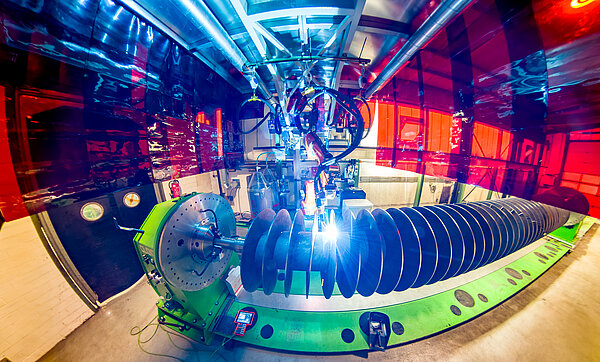
With a welding source of up to 600 amperes and a payload of up to 20 tonnes, we now weld even more efficiently and precisely. We easily handle workpieces up to 15 m in length.
Thanks to integrated laser measurement and transparent process monitoring, we guarantee the highest quality and repeatability. This means more capacity and planning reliability for your projects.

The exciting thing about engineering is turning a good idea into a plant that reliably masters even the most difficult processes. Whether we adapt the proven hollow flight principle or go fully electric at high temperatures with LiquiCore — we put all our know-how into the design so that the machine runs absolutely reliably at the customer's site from day one.
David Brück, Head of Project Engineering Polymer Mixing & Conveying TechnologyWe look forward to your call:
+49 (0)2691-308-0Send us an e-mail:
info@koellemann.deUse our contact form:
To the contact form
Köllemann GmbH
Am alten Wehr 9‑12
53518 Adenau, Germany
Phone: +49 (0)2691-308-0
E-mail: info@koellemann.de